
Our First Real Overnight Test In A VW Golf Estate: What Worked And What Didn't
It's amazing how competent a sleeping setup looks when it's sitting on your driveway. Everything fits. The mattress unfolds cleanly. The window covers go up without a fight. The conversion takes 3 minutes 48 seconds. You stand back, look at the result, and feel reasonably confident about what you have built.
Then you take it on an actual trip.
This was our first real overnight test of the VW Golf Estate sleeping setup, built into a shakedown trip to the EKO 25h Race of Bulgaria at Karting Track Pautalia in Kyustendil. The trip was not primarily about testing sleeping arrangements. It was about attending a race my son had been looking forward to, spending a day and night together, and finding out whether a travel system that looks sensible on a driveway holds together when real life is added to it.
We had visited Kyustendil the previous year on a day trip. The route was familiar. The town was not unknown. That was a deliberate choice. I did not want to be navigating an unfamiliar city at midnight while also learning whether the spare wheel fits behind the driver's seat. I'd deliberately picked somewhere we'd already visited. The last thing I wanted was to be testing a sleeping setup and trying to work out an unfamiliar town at the same time.
A driveway tells you whether the mattress fits the car. A real trip tells you where the spare wheel actually ends up, what happens when an ice bag leaks, and whether there is any relationship between a controlled test and a night involving two people, all their gear, a karting event, a supermarket run, and an evening meal. Those were the things we needed to learn.
Karting Track Pautalia
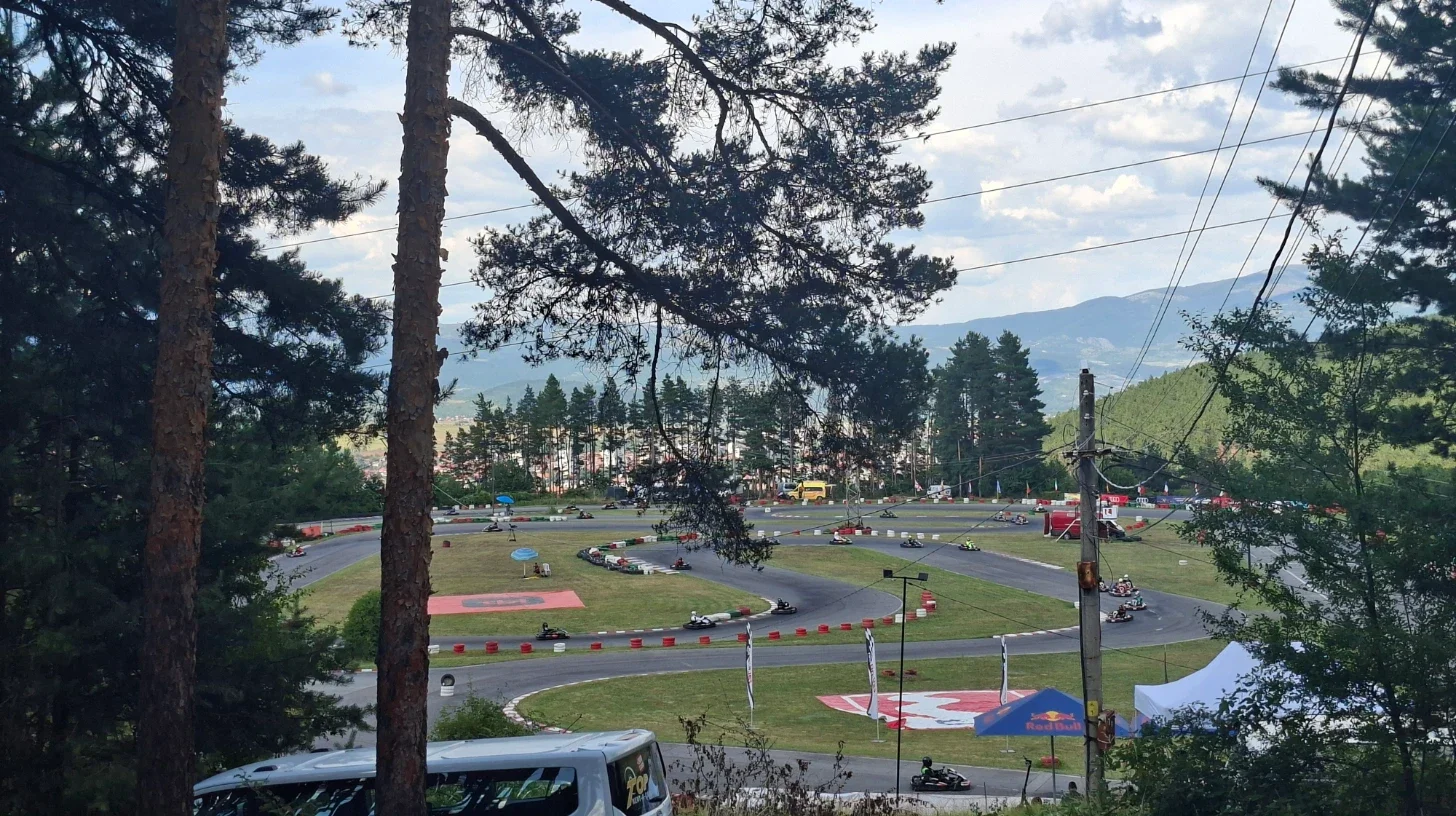
The circuit sits above Kyustendil on elevated ground. From parts of the track area there are views across the valley below. It's a proper kart circuit rather than a temporary setup, and it’s a venue built for events like this.
We arrived in the afternoon. The car park was busy but finding a reasonably flat space was not difficult. The facilities were better than expected. Toilets were clean and remained so throughout the night. Food at the track was good value: chicken fillet, grilled bread, potato salad and lutenitsa for €8.50. Two ice creams cost €4. For a race event this is reasonable.
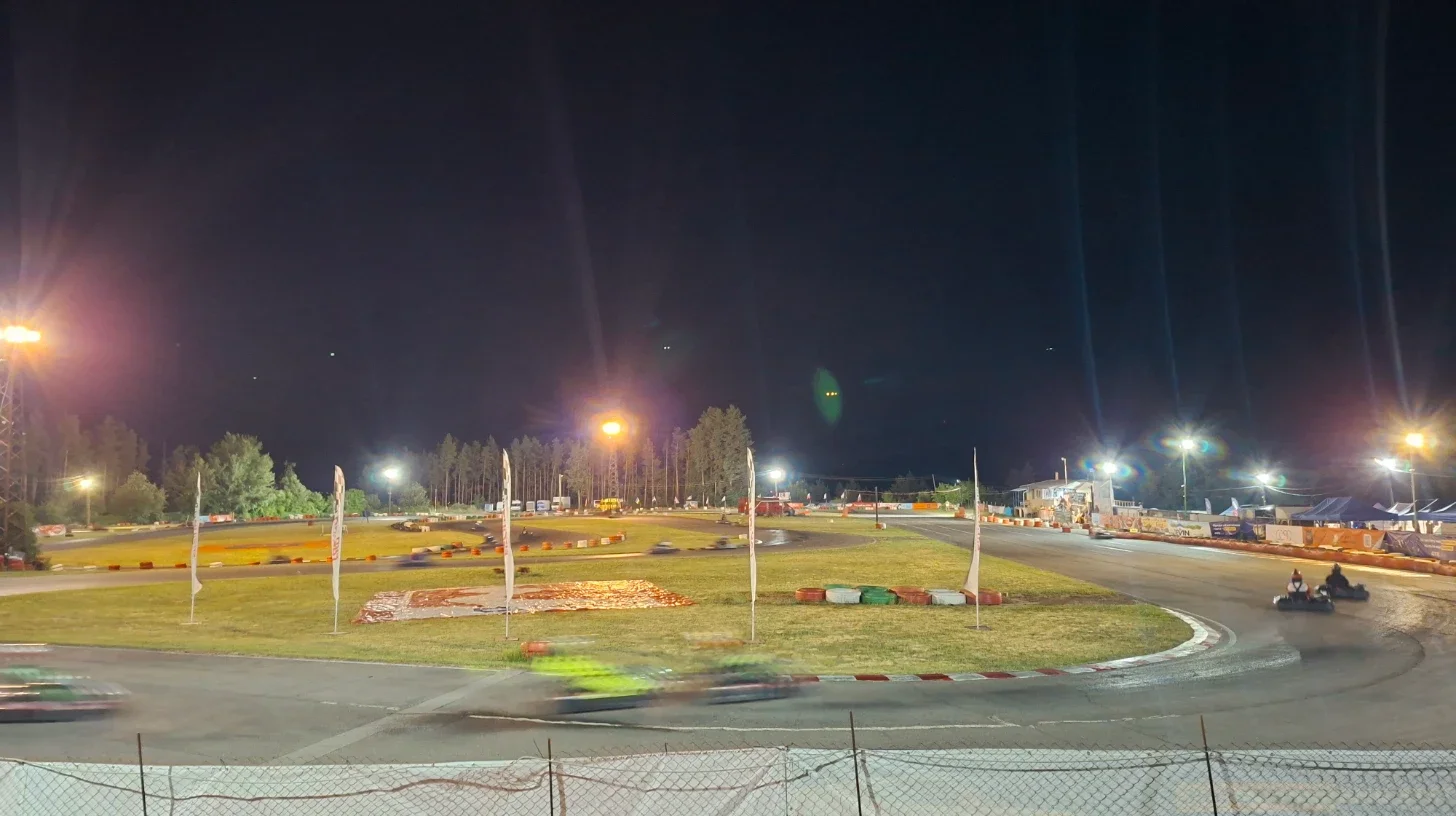
The place felt completely different after dark. During the afternoon it felt like any other race meeting. By midnight there were still karts circulating, teams still working and people still wandering around the paddock, but everything had slowed down a bit. The circuit lights the track but the surrounding area darkens. The crowd thins but does not disappear. There are teams working in the pits, the sound of karts on the circuit, occasional movement around the car park. It wasn't quiet, but it never felt disruptive either. Everyone who was still there had a reason to be there.
That ended up being relevant to how the night felt.
Cameron Das
My son follows Cameron Das on YouTube. Cameron covers karting extensively and my son watches his content regularly. What we did not know when we set off for Kyustendil was that Cameron's team would be competing in the race.
We discovered this at the circuit and spent parts of the day tracking the team's progress and watching for Cameron around the paddock. After one of his evening stints, we went to the pits. He stopped, said hello, gave my son a fist bump and posed for a photograph. He came across as genuinely friendly.
To be clear, this wasn't the reason we came to Kyustendil. It's the sort of thing that never appears in the trip planning stage but often ends up being the bit you remember afterwards.
We did not plan this trip around Cameron Das. We planned it around a race and a sleeping test. Because we were there, because the trip was affordable enough that attending it was not complicated, the encounter happened. My son will remember that fist bump long after he has forgotten anything about mattress thickness or condensation levels.
Finding Somewhere To Sleep
Before the trip, two alternative overnight parking locations in Kyustendil were researched.
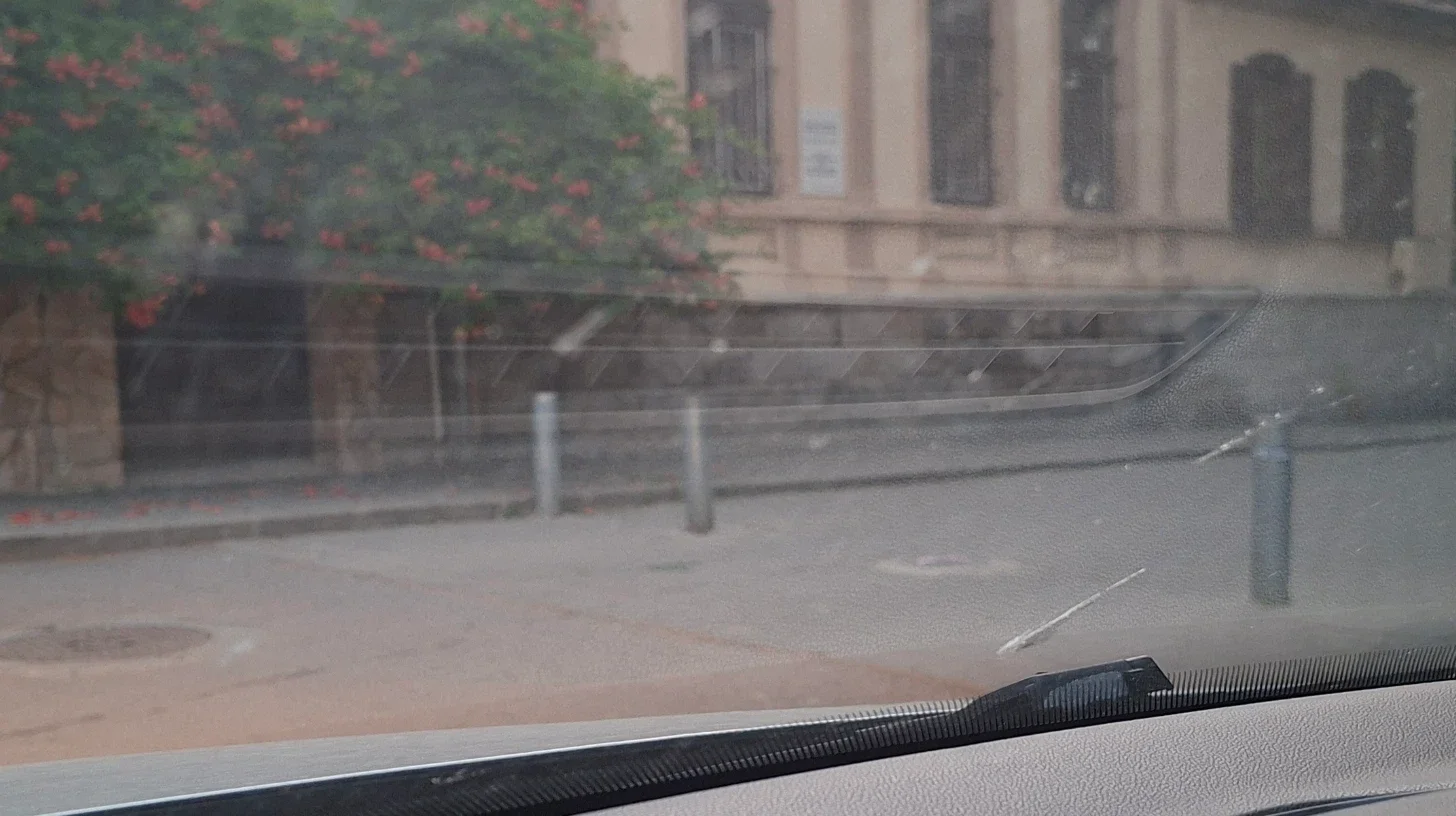
The first, on ul. Patriarh Evtimiy, was suggested by an AI mapping tool. On arrival, the location appeared to be blocked by bollards. A central bollard had apparently been lowered at some point, but the legality of overnight parking there was unclear and I wouldn't feel comfortable recommending it to somebody else.
The second option was near an old spa building, on a street close to the centre. No staff were present, but there was a steady flow of pedestrian and cyclist traffic throughout the evening. It was possible as an emergency fallback but felt unsuitable as a considered choice.
Neither location felt like somewhere I'd actually choose to spend the night. We returned to the circuit.
In retrospect the circuit was the right call, and not only because the alternatives were weak. The circuit had toilets available through the night. It was staffed and active. The other vehicles present were occupied by people connected to the race. There was nothing unusual about a car that had not left. And crucially, we had already been there all day, which meant arriving at a dark, unfamiliar location at 11pm was not part of the experience.
One thing this trip reinforced is that I still want a backup plan before I arrive somewhere. Knowing what the options are before you need them, and ruling out the weak ones in daylight, removes a category of problem that gets considerably harder to solve when you are tired.
Evening Meal And Supplies
Dinner was at The Garden restaurant in Kyustendil. Wiener schnitzel and chips, chicken goujons with mayonnaise, fried cheese with blueberry jam, soft drinks. Cost approximately €26. The food was acceptable but slightly dry.
Before returning to the circuit we stopped at Kaufland. Croissants, drinks and snacks for the morning and night came to approximately €13.
This is also where the cool box lesson happened.
A bag of ice in the cool box leaked overnight. Sandwiches placed directly on the ice bag were wet and had to be thrown away. Food stored in sealed containers was unaffected.
It's the sort of thing you only discover once you're actually away from home. The cool box worked. The assumption that an ice bag is watertight did not. Any food that needs to stay dry now goes into a sealed container regardless of where it sits in the cool box. Obvious in hindsight. Less obvious when you're packing the coolbox at home.
Setup: The Gap Between The Driveway And Reality
The driveway setup time was 3 minutes 48 seconds. The real-world setup took just under 20 minutes. I'm actually pleased it took 20 minutes, because if it had still taken 3 minutes 48 seconds I'd have known I hadn't packed enough.
That difference is one of the most practically useful findings of the trip, and understanding it requires understanding what a real trip actually introduces.
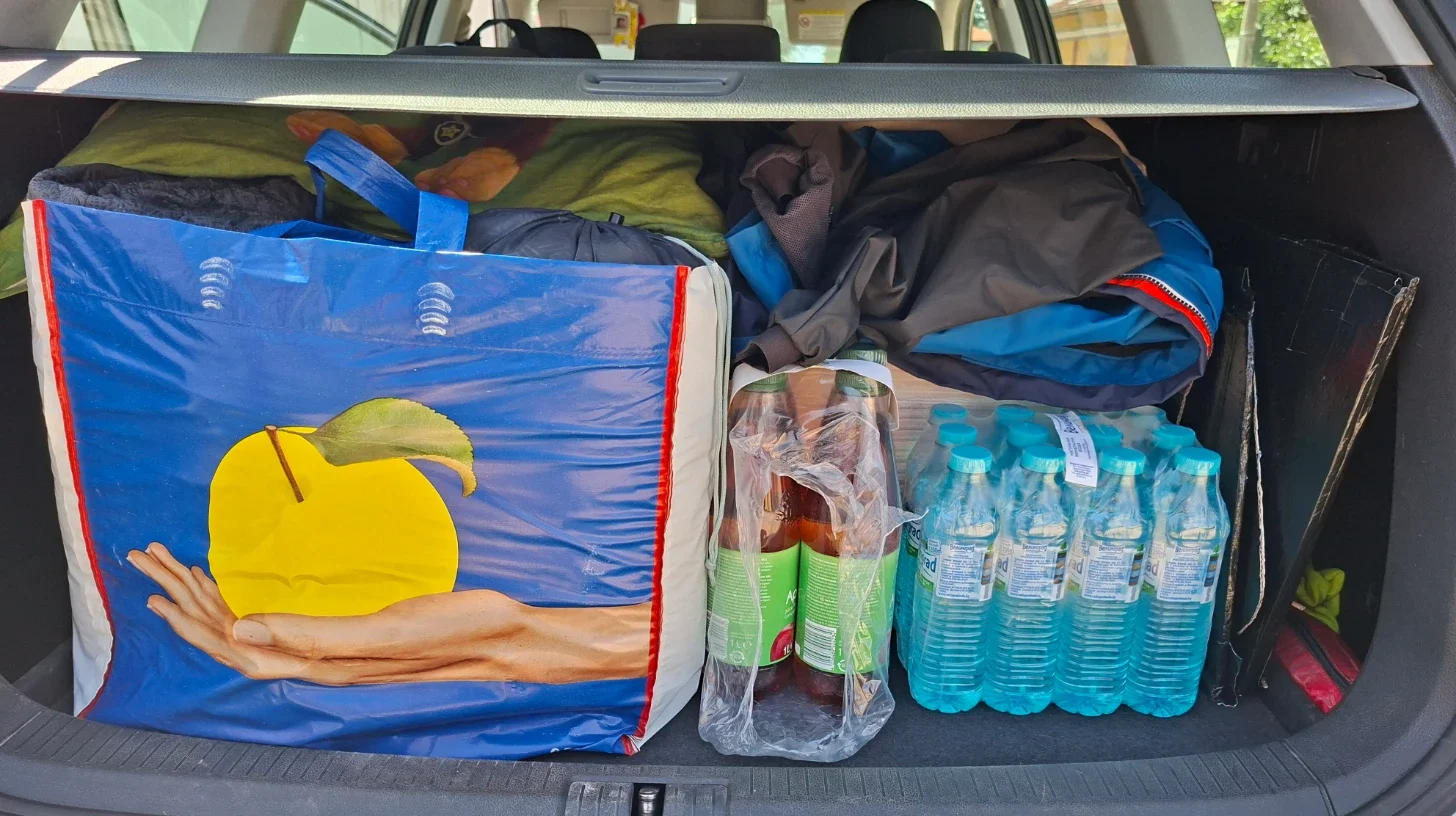
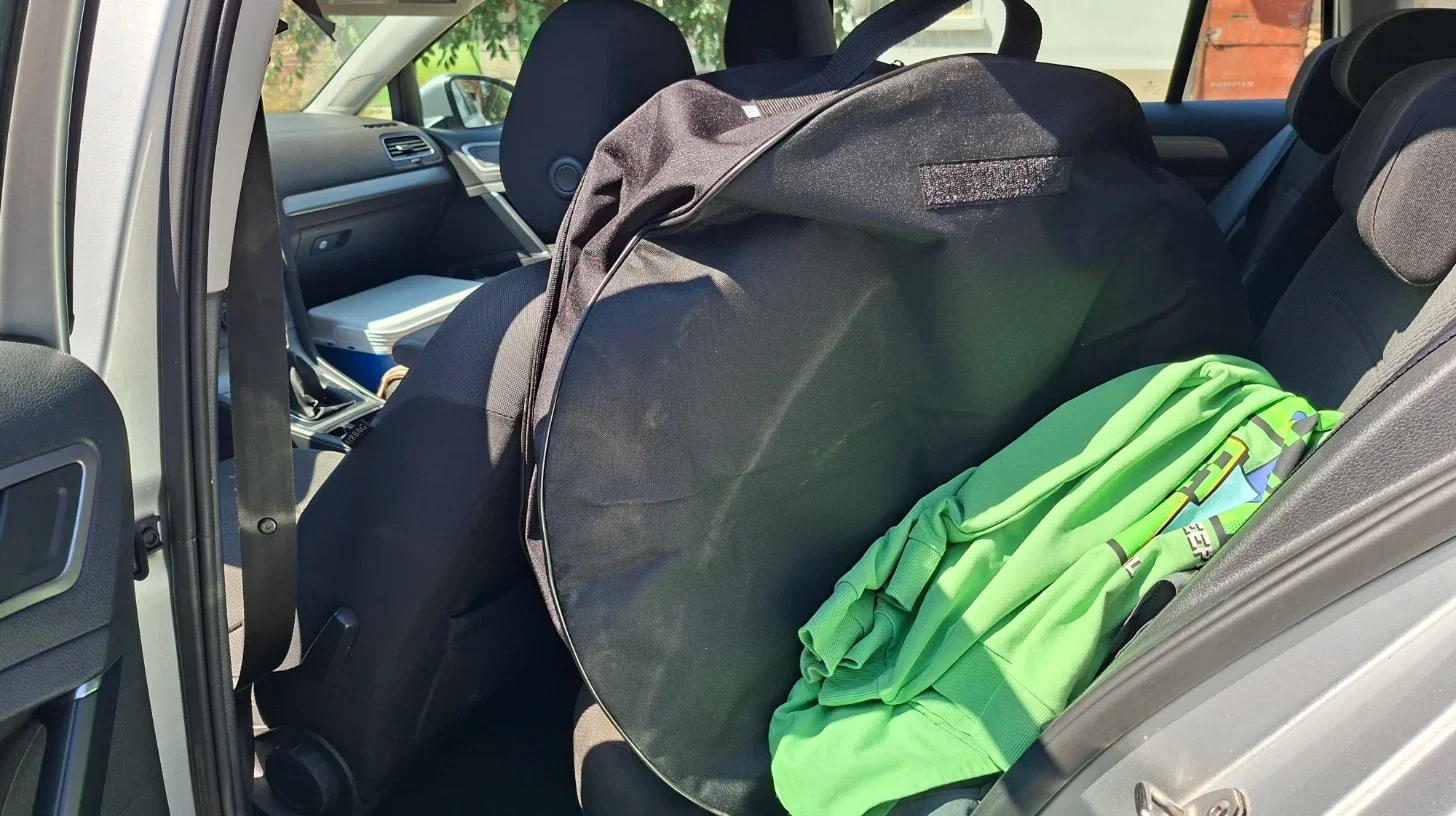
A driveway test takes place in daylight, with an empty car, with no other variables. A real trip ends with clothes distributed across the back seat, Kaufland bags that need somewhere to go, a cool box in its daytime position, a parcel shelf that has been slid out to allow rear window access, and a spare wheel situation that deserves its own paragraph.
The plan had the spare wheel living behind the driver's seat during travel. On this trip, with everything else that needed that space, the spare wheel would not fit there. It ended up on the front driver's seat. The parcel shelf went on the front passenger seat. Clothes and snacks occupied the space behind the driver's seat that had been allocated to the spare wheel. The cool box moved to the rear passenger footwell, which was always the night plan and which worked well. The cargo net handled the small items that would otherwise have been on the mattress.
Everything found a place in the end, but it wasn't the neat little system I'd imagined on the driveway. We ended up making it up as we went along, moving things around until everything fitted. That's what took the extra time.
I don't see that as a failure. That's exactly why we did this trip before attempting anything bigger. I'd much rather discover these little problems in Kyustendil than halfway through a week-long road trip. The storage logic that works on a driveway needs to be tested with a fully packed car, not with an empty boot. A trip with a child, two nights of clothing, food supplies, and circuit-day purchases is a different problem from a mattress and two sleeping bags on a clean floor.
Pack-down the following morning took approximately 15 minutes. No significant issues.
Privacy, Ventilation And Condensation
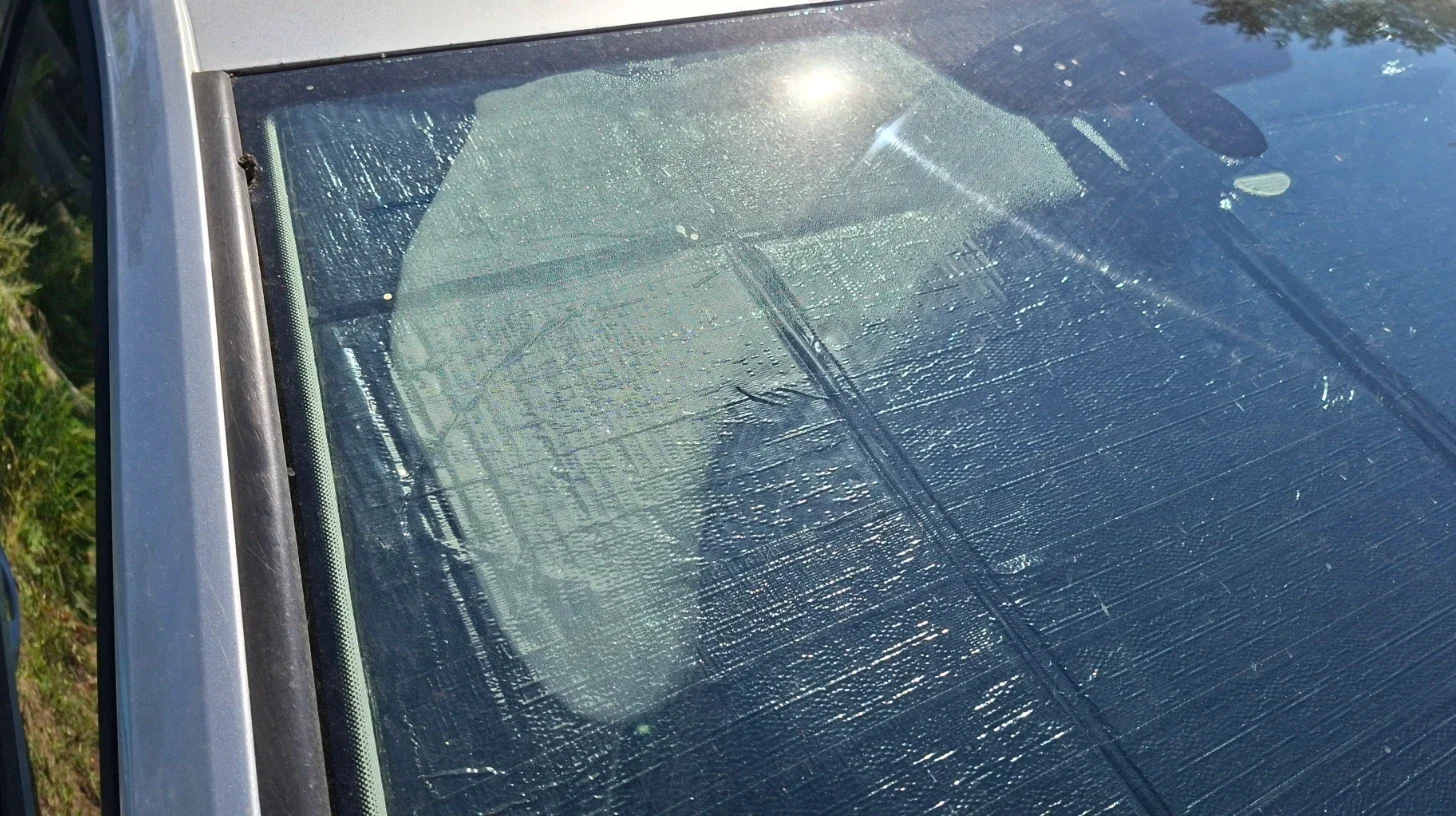
The window covers worked well. The interior was effectively blacked out. From outside, during our checks, it was impossible to see in. There were minor light leaks at a few edges which a credit card pushed back into position without difficulty. The covers did not detach during the night.
The rear windows were each opened approximately 1 cm. A small USB fan ran throughout the night from a power bank. By morning approximately 75% of the power bank charge remained. If it performs the same way on future trips, one charge should comfortably last several nights.
Condensation appeared on the front windscreen and a small section of the front passenger window. Nothing else. Two people breathing in a closed vehicle for several hours is a meaningful source of moisture, and restricting condensation to those two surfaces represents a better result than was expected. Based on this trip, the cracked windows and fan seem to be doing their job. One night isn't enough to draw firm conclusions, but it's certainly a promising start.
The Sleep Itself
We settled in with heads at the boot end and feet pointing toward the front seats. Within a relatively short time that orientation was uncomfortable.
At approximately 00:55 I woke up, used the circuit toilets, had a drink and we reversed direction, heads toward the front seats and feet in the boot. That felt better.
The mattress itself was comfortable. The more likely source of the discomfort in the first orientation was the transition between the folded rear seats and the boot floor. There is a step at that point, and with heads at the boot end it sits in an awkward position on the body. It is probably the same reason that people building permanent sleeping platforms go to the trouble of eliminating that step. It matters more than it appears to in driveway testing.
My son is approximately 147 cm tall and has a tendency to spread out while sleeping. Two sleeping bags were used as bolsters along the sides to create usable width, which worked reasonably well. One pillow each was brought. Two each would have been noticeably better.
Estimated sleep ran from approximately 01:50 until 07:00, with resting in place until around 08:30. Kart noise was less disruptive than expected. Midnight fireworks, marking a track direction change, were loud but brief. Some movement around the car park through the night was audible but not significant.
Sleep quality: approximately 3 to 4 out of 10.
That is not good sleep. It is honest to say so. Equally, it is honest to say that the problems are specific rather than fundamental. None of these problems feel difficult to fix. The pillow situation requires only remembering to bring more pillows. None of this requires rebuilding the system.
The thing I keep coming back to is that the setup and the sleep aren't the same thing. The window covers, the fan, the condensation management, the cargo net, the cool box position all performed as intended or better. The sleep quality was a product of specific, identifiable problems with orientation and padding rather than a general verdict on sleeping in a Golf Estate.
What This Trip Cost
Fuel: €19
Track food and ice creams: €12.50
Dinner: €26
Kaufland: €13
Total: approximately €70
Accommodation: €0
For context, accommodation options in Kyustendil researched before the trip ranged from approximately £48 to £377 per night.
The numbers are interesting, but they aren't really the point. The question that matters is not what we saved but what €70 total made possible. A full day at a major karting event. A proper evening meal in town. Morning supplies. Fuel for 316 km. A night that tested a travel system in real conditions. Time together at something we both cared about.
Coming Home With More Than We Left With
The shakedown trip produced a list of specific things to address before the next overnight.
The spare wheel storage plan needs rethinking for a fully loaded car. The parcel shelf needs a cleaner system during conversion. Pillows: two each rather than one. The seat-to-boot transition is worth addressing, whether through padding, a different mattress fold, or a change in sleeping orientation that avoids the problem entirely. The food storage system needs to account for ice bag leaks as standard.
If anything, this is exactly what I wanted the trip to do.
Most of the things we'd hoped would work actually did. The window covers gave us the privacy we wanted. The fan and cracked windows kept condensation under control. The cargo net turned out to be far more useful than I'd expected. Even the mattress itself wasn't the problem once we'd turned ourselves round.
My son met someone he follows online at a race he had been looking forward to. We spent a day and a night together at a circuit above a Bulgarian valley. More importantly, we came home knowing exactly what we'd change before the next trip.
We simply wouldn't have learned any of that on the driveway. That's why I'm glad we chose Kyustendil as our first overnight test. Before we think about Veliko Tarnovo, Thessaloniki or anything further afield, we've already fixed a whole list of things in our heads. We didn't come home thinking about the poor night's sleep. We came home talking about the race, meeting Cameron Das and everything we'd do differently next time. To me, that's exactly what a shakedown trip is supposed to achieve.
