
Best Window Covers For Vehicle Camping
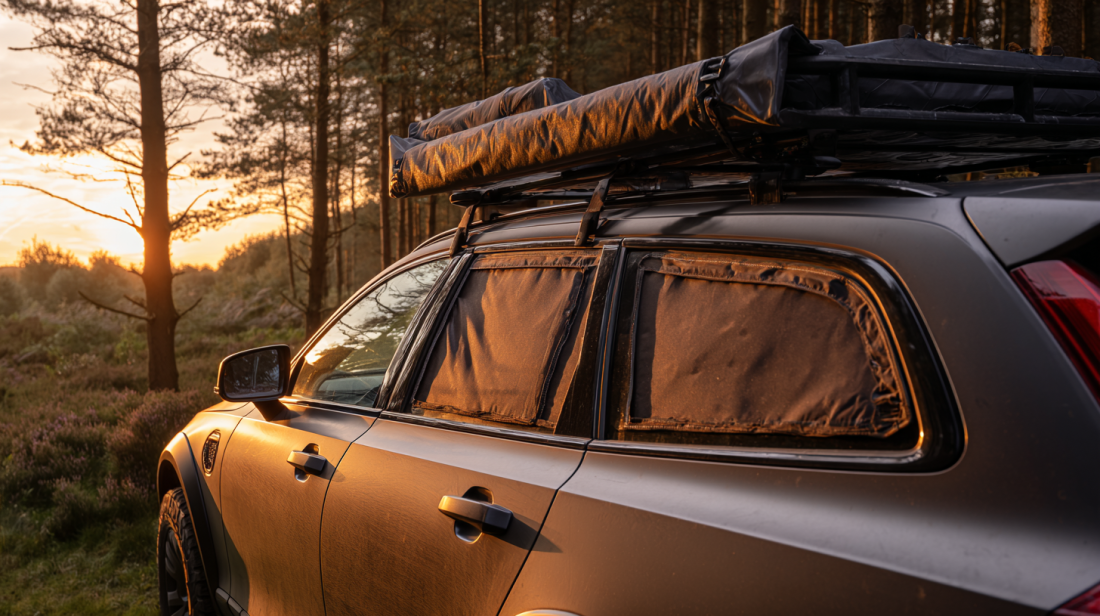
Window covers are one of those things you don't think about until you've slept without them. Then you spend the night being woken up by passing headlights, lie there at 5am with bright sunlight in your face, or realise anyone walking past can see exactly what's going on inside your car.
They're not glamorous kit. But they make a real difference to how well you sleep. If you're still refining your overall sleeping setup, our guide on how to sleep comfortably in a small car covers the fundamentals.
This covers the main options, what each one is actually like to use, and how to make a decent set yourself for almost nothing.
Why Window Covers Matter
Privacy
Parked in a residential street, a services, or a rural lay-by, you're visible to anyone who walks past or pulls in nearby. Window covers make the interior of the vehicle opaque from outside. That's useful for obvious reasons — nobody can see you sleeping, see your gear, or see that the car is occupied at all.
This matters for personal comfort as much as security. Being able to settle in without feeling exposed makes a genuine difference, especially if you're new to vehicle camping and using it as a way to reduce accommodation costs while travelling. Our guide on how to sleep in your car without feeling exposed covers the wider privacy considerations that affect sleep quality and confidence overnight.
Window covers improve privacy, but they don't change local parking regulations. See Where Can You Legally Sleep In Your Car? A Country-By-Country Guide for country-specific guidance.
Light Blocking
Streetlights are a constant problem in car parks, services, and residential areas. They're usually orange or white, they're often directly aimed at vehicle level, and they don't turn off at midnight. Without window covers, even a distant streetlight is enough to prevent deep sleep.
Early morning light is the other issue. In summer, sunrise in the UK is around 4:30am in June. A car with uncovered windows becomes fully lit very quickly after that. If you're relying on natural tiredness to sleep until 7am, uncovered windows will stop that from happening.
Heat Management
Reflective window covers reduce heat gain in summer by reflecting sunlight before it enters the vehicle. A car parked in direct sun with uncovered windows can become genuinely hot inside — warm enough to affect sleep quality even after sunset.
In cold weather, window covers add a small layer of insulation between the cold glass and the interior air. Glass loses heat quickly. A cover pressed against it traps a thin layer of air that slows that process. It's not dramatic insulation, but it's a real effect across a full night — particularly relevant if staying warm while vehicle camping is already a challenge. If cold nights are a recurring problem, see our guide on how to stay warm while vehicle camping for a complete breakdown of sleeping bags, insulation and layering.
Does Your Car Already Have Privacy Glass?
Many modern cars come with factory-fitted privacy glass on the rear windows — the darker tinted glass that's common on SUVs, MPVs and some hatchbacks. It's worth knowing what it actually does before assuming it replaces window covers.
Factory privacy glass reduces visibility into the vehicle in daylight, but it doesn't block light from outside at night. Streetlights, passing headlights and car park lighting still come through. It also provides no meaningful insulation.
If your car has privacy glass on the rear side windows, you may find that those windows need less attention to privacy during the day, but you'll still want covers for overnight sleeping. The rear windscreen and front windows are almost always clear glass regardless of what the sides have, so those still need covering.
The practical effect is that privacy glass changes which windows to prioritise, not whether to use covers at all.
Window Covers And Condensation
Worth being clear about this upfront: window covers reduce heat loss through glass but they don't eliminate condensation. If anything, a fully covered, well-insulated vehicle with no ventilation can accumulate moisture faster because there's nowhere for it to go.
Covers help by keeping glass surfaces slightly warmer, which slows condensation formation. But you're still breathing out moisture all night, and that moisture needs somewhere to go. Cracking a window for ventilation remains important even when covers are fitted — in fact, especially then.
Condensation management is a separate topic, but it's closely connected to window cover use. If you're dealing with heavy overnight condensation, covers alone won't solve it. For a deeper look at managing moisture, read our guide to car camping condensation: causes and solutions.
Types Of Window Cover
Reflectix
Reflectix is a silver foil-and-bubble-wrap insulating material sold in rolls at DIY shops and online. It's the most popular DIY material for vehicle camping window covers, and for good reason.
Cut to the shape of each window and pressed against the glass, it blocks all light, provides some insulation, and costs very little per panel. A single roll is enough to cover every window in most cars with material left over.
The main limitation is that it doesn't stay in place on its own. It needs to be pressed into the window frame or held in by tension. This works well on windows with a clear frame, less well on curved windows or rear windscreens with complex shapes. Some people add thin magnets or velcro tabs to help it stay put.
It also looks obviously like someone has covered their windows from the outside — more on this below.
Best for: DIY setups, anyone on a tight budget, or people who want to build their own covers before deciding whether to invest in something more polished.
Magnetic Window Covers
Magnetic covers are made from a flexible material with embedded magnets that attach directly to the metal door frame around the window. They're faster to put up and take down than Reflectix panels, they stay in place without any fiddling, and they look tidier.
The downside is cost — a full set for a specific vehicle runs to more than a DIY alternative. They also need to be bought for your specific car make and model, so check compatibility carefully. Generic magnetic covers often don't fit well, which defeats the purpose.
They work best on doors with a consistent metal frame all the way around the window. Some vehicles have awkward door designs or mixed materials that reduce how well the magnets grip.
Best for: People who want a quick, tidy setup and are willing to spend more for convenience.
Suction Cup Covers
Suction cup covers are fabric or foam panels that attach to the glass using small suction cups. They're available in generic sizes and custom-fit versions.
In practice, suction cups are the least reliable attachment method. They work initially but tend to fall off overnight, particularly when temperatures drop and the glass contracts slightly, or if the glass has any curvature. Waking up at 2am to a cover that has dropped is irritating.
They're also difficult to make fully lightproof around the edges because suction cups hold the cover slightly away from the glass, leaving gaps.
Best for: Occasional use where a cover falling off during the night isn't a big problem — perhaps for a nap rather than a full night's sleep.
Curtains
Curtains suspended from a rod or wire are common in campervan conversions. They work well for vehicles where the sleeping area is separated from the front — behind the front seats, hanging from a rail.
For standard cars and estates, internal curtains are harder to fit neatly. You need something to hang them from, and most car interiors don't have obvious fixing points. Bungee cords or tension rods fitted between the grab handles or door pillars are workable solutions, but they take some setup.
Curtains don't insulate as well as Reflectix because they don't sit against the glass — they hang in front of it, leaving a gap. They're better at blocking light than retaining heat.
The advantage is that they look more domestic and less obviously like a vehicle camping setup. They're also easy to open and close if you need to check your surroundings without getting out.
Best for: Van and campervan conversions, or anyone doing longer-term vehicle camping who wants a tidier interior.
DIY Options
Beyond Reflectix, there are a few other DIY approaches worth knowing about.
Cardboard — free, works surprisingly well for light blocking, and cuts to any shape easily. The obvious problem is that it absorbs moisture from condensation and deteriorates quickly. Fine for one or two nights; not a long-term solution.
Black-out fabric — available from fabric shops by the metre, blackout fabric cuts to shape, can be hemmed to prevent fraying, and blocks light completely. Held in place with velcro tabs stuck to the window frame, or tension from fitting it into the window channel, it's more durable than Reflectix and looks better. It doesn't have the insulating properties of foil-backed material, but for light blocking and privacy it's very effective.
Yoga mats — closed-cell foam yoga mats can be cut to window shapes, provide some insulation, and are easy to work with. Not as light-blocking as foil without an additional layer, but useful if you have one to hand.
Which Window Covers Look Least Obvious From Outside?
Privacy and discretion aren't quite the same thing. Privacy means people can't see inside. Discretion means people can't easily tell the car is occupied at all.
Silver Reflectix pressed against every window is the least discreet option. From outside, it's immediately recognisable as a vehicle camping setup. In a rural lay-by that doesn't matter much. In a residential street or a car park with residents, it can attract attention or prompt someone to knock on the window and ask if everything's alright.
Magnetic covers in dark colours — charcoal, navy, black — look more like aftermarket privacy glass from a short distance, especially on rear windows where tinted glass is common anyway. They don't draw the same attention as silver foil.
Internal curtains in dark fabric are the most discreet option of all, provided they're not billowing obviously or backlit from inside. From outside, drawn dark curtains look far less unusual than foil panels.
The front windscreen is the giveaway on most setups. A large silver panel on the front is visible from distance and makes it immediately obvious that someone is sleeping in the car. Facing the vehicle away from pedestrian areas, or covering the Reflectix with a dark fabric layer on the outward-facing side, reduces how obvious it looks.
For most vehicle campers, this level of stealth isn't necessary. But if you're regularly sleeping in urban areas or places where discretion matters, it's worth thinking about which covers you use on which windows — not just whether they block light.
Quick Comparison
Reflectix (DIY) — Cheapest option, excellent light blocking, good insulation, but not very discreet.
Magnetic Covers — Most convenient option, quick to install and remove, but more expensive.
Suction Cup Covers — Cheap and easy to buy, but can fall off during the night.
Internal Curtains — Very discreet and easy to use once installed, but provide little insulation.
DIY Blackout Fabric — Very cheap, excellent privacy and light blocking, but limited insulation.
How To Make Simple DIY Window Covers
The most practical and cost-effective approach for most car campers is Reflectix cut to fit each window. Here's how to do it properly.
What you need:
- A roll of Reflectix (or similar foil-bubble-wrap insulation)
- Scissors or a sharp knife
- A marker pen
- Cardboard for templates
Method:
Make a cardboard template for each window before cutting any Reflectix. Hold the cardboard against the glass from inside the vehicle and trace the shape. Cut it out and check the fit — it should sit inside the window frame with slight tension to help it stay in place.
Once the template fits well, trace it onto the Reflectix and cut it out. Label each panel — rear left, rear right, rear windscreen, and so on — because the shapes are similar enough to mix up easily.
The front windscreen is the largest and most important panel. It also needs to stay in place without a window frame to tension against. Folding the edges slightly so they press against the dashboard and sun visors helps. Some people cut the front panel in two so it's easier to store.
Adding a dark outer layer: If discretion matters, cut a piece of dark blackout fabric to the same shape and glue or velcro it to the outward-facing side of each Reflectix panel. The foil faces inward for insulation; the dark fabric faces the glass. From outside, it looks like dark glass rather than a foil setup.
Storage: Store panels flat if possible — stacking them in the boot between a rigid board and the boot wall prevents warping. Reflectix that's been rolled or crumpled doesn't sit flush against the glass, which creates light gaps and reduces insulation. A simple cotton bag or an old pillowcase keeps a flat set of panels together without them getting bent.
Durability: A well-made Reflectix set lasts two to three years with regular use before the foil starts to separate or panels warp beyond being useful. Fabric-covered panels last longer because the fabric protects the foil layer from abrasion. If a panel starts to delaminate at the edges, a strip of foil tape buys more time before you need to remake it.
Test the full set before a trip. Check that each panel stays in place overnight and that there are no significant light gaps around the edges. Velcro tabs can address any panels that slip.
Total cost for a full set is usually between £10 and £20 depending on how much Reflectix you need.
Reflectix was our original plan too. In the end, sourcing it locally proved harder than expected, so we solved the problem a different way in our VW Golf Estate sleeping setup.
Common Mistakes
Covering only the rear windows. The front windscreen is the largest glass surface in the car. Leaving it uncovered means light comes in from the front and illuminates the whole interior. Cover every window, including the front.
Cutting panels too small. A cover with gaps around the edges lets light in and reduces the insulating effect. Err on the side of slightly too large — you can always trim it down.
Not labelling the panels. Each window has a slightly different shape. Unlabelled panels mean fitting them by trial and error in the dark when you want to go to sleep.
Forgetting the rear quarter windows. Small triangular windows at the rear corners of many hatchbacks and estates are easy to overlook. They're also at eye level for anyone walking past. Cover them.
Relying on suction cups for all-night use. Suction cups fail. If you're building a set of covers you'll use regularly, plan for a different fixing method.
Sealing the vehicle completely and skipping ventilation. Fully covered windows with no cracked window means moisture builds up overnight with nowhere to go. Good window covers and good ventilation go together — one doesn't replace the other.
Storing panels rolled or bent. Warped panels don't sit flush against the glass. Store them flat.
Turning the interior light on before fitting covers. Setting up bedding, looking for gear, or using your phone with the interior light on before the windows are covered turns the car into a lit display case. Anyone nearby can see exactly what's happening inside. Fit the covers first, then organise everything inside.
Which Option Is Best For Most People?
For a beginner or anyone on a budget: DIY Reflectix panels. Cheap, effective, and you can make a full set in an afternoon. Add a dark fabric layer on the outward-facing side if you're sleeping in urban areas or want to be less conspicuous.
For someone who camps regularly and wants convenience: custom-fit magnetic covers for the door windows, combined with DIY Reflectix for the front and rear windscreens which magnetic covers don't typically cover.
Curtains make sense if you're converting a van or doing longer-term camping. For regular cars and estates, they're more effort than they're worth given the fixing challenges.
Suction cup covers are the weakest option for overnight use. Fine for daytime sun blocking; not reliable enough for a full night.
Final Thoughts
A set of well-fitted window covers costs almost nothing to make and fixes several problems at once — light, privacy, insulation, and discretion if you choose the right materials. Combined with a good sleeping surface and the right pillow, window covers can make a surprising difference to sleep quality. Our guide to the best camping pillows for car camping compares the main options.
For most beginners, the practical starting point is a DIY Reflectix set covering every window including the front. Make cardboard templates first, label each panel, store them flat, and add dark fabric to the outward-facing side if you're camping in built-up areas. That setup handles the majority of situations and costs under £20.
If you camp regularly and value the convenience of a faster setup, custom magnetic covers for the door windows are worth the extra cost. They go up and come down in seconds, which matters more than it sounds after a long day of driving.
Whatever you use, keep a window cracked. Covers do a lot, but they don't replace ventilation — and a warm, well-covered, completely sealed car is still going to have wet windows by morning.
Window covers are just one small part of a larger goal: making more adventures possible for less money. They're one piece of a wider process that includes choosing routes, planning overnight stops, budgeting for trips and finding worthwhile places to visit along the way.
